
Address: Hans-Grade-Allee 5, 12529 Schonefeld b. Berlin, Germany

Nano 2026
University of the Free State, South Africa
Title : Nanostructured Electrodes and Intelligent Testing Platforms for Next Generation Energy Devices
Abstract:
The global push for sustainable energy has accelerated interest in sodium-ion batteries and supercapacitors as viable alternatives to lithium-ion systems. However, widespread adoption is hindered by two critical challenges: the absence of standardized, affordable electrochemical characterization tools and the need for advanced materials that deliver high performance. This work addresses both by developing a low-cost, microcontroller-based smart instrumentation platform capable of precise charge–discharge control, programmable constant currents, and real-time data acquisition. Designed for scalability and resource-constrained environments, the systems designed are validated against existing systems to international standards to ensure reliability and reproducibility. In parallel, novel, nanostructured alloy electrodes and ion-selective membranes are engineered to enhance ion transport, surface area, and energy density. Future integration of simulation-driven optimization will enable predictive modelling of electrode architecture and device performance, bridging experimental design with computational insights. By combining nanoscale material innovation with intelligent device engineering, this research establishes a framework for standardized testing and accelerated development of next-generation energy storage technologies. The anticipated impact is twofold: democratizing access to advanced characterization tools for global research communities and advancing nanomaterial-based energy systems that support national and international sustainability goals. Ultimately, this work positions locally developed, cost-effective solutions at the forefront of nanotechnology-driven energy innovation, paving the way for scalable, high-performance devices that meet the demands of future energy infrastructures.
Biography:
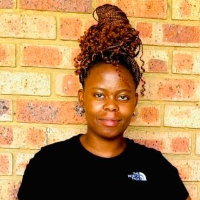
Mbali Marole (MSc in Nanoscience, cum laude) is a Ph.D. candidate at the University of the Free State and Junior Lecturer at the Vaal University of Technology. Her research focuses on electrochemical characterization of low-cost but efficient Sodium-ion and Lithium-ion energy storage devices. She has presented at national and international photonics conferences and has some output published in accredited journals. She has served as a research assistant in the Physics department. Her doctoral research is hoping to advance nanotechnology-driven energy storage solutions with strong alignment to national priorities in sustainable energy.