

Address: Hans-Grade-Allee 5, 12529 Schönefeld b. Berlin, Germany

Optics 2026
Universite Paris Cite, France
Title : Heterodyne Laser Correlation Spectroscopy: An Interferometric Method for Measuring Nanoparticle Velocity
Abstract:
In a
flowing solution of motorized nanoparticles, propelled objects undergo both
directed flow and random diffusion, and equations for forced diffusion can be
used to describe this situation. Dynamic
laser light scattering (DLS or photon correlation spectroscopy) is a
well-established technique for measuring particle size over the size range from
few nanometers to few micrometers and a technique of choice for studying the
dynamics of solutions and in particular diffusive processes due to Brownian
motion. However, the average drift velocity of particles, in a directed flow is
inaccessible in a standard homodyne DLS experiments. The study of ballistic
motions or forced diffusion requires advanced heterodyne DLS experiments. In such experiments a reference beam,
which is a small fraction of the intensity of the incident laser light, is
mixed with the light scattered from the sample, allowing measurement of
dynamical structure factors characterized by both real (diffusion) and complex
(ballistic velocity) processes. Important. The heterodyne intensity-intensity
correlation function, g(2)(q,),
is an oscillating function of the time lag with a velocity-dependent frequency
that requires complex analyses and comparison with theoretical models.
Such recent optical setup
and method recently enabled us to study complex motions of active
nanoparticles.
Biography:
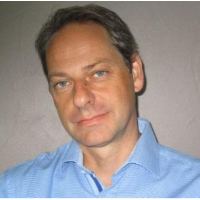
Eric Buhler currently holds a Full Professor position in soft condensed matter physics at universite paris cite (France). In 1996, he received his Ph.D. degree in physics at the university of Strasbourg investigating the structural and dynamical properties of wormlike micelles. Prof. E. Buhler subsequently obtained a postdoctoral position (1996-1998) at the university of North Carolina at Chapel Hill (USA), where he studied the structural behavior of copolymers in supercritical carbon dioxide using scattering techniques. In !998, he joined the University of Grenoble, France, where he obtained an Associate Professor position (1998-2006). He spent two years (2002-2004) at the French National Research Center (CNRS) of Montpellier (Charles Coulomb Institute) as a Visiting Professor. In 2006, he joined the Université Paris Cité, where he is currently a Full Professor. His research focuses on the structure and dynamics of complex systems. He is specialist in laser light, neutron and X-ray scattering as well as in photon correlation spectroscopy. He has published more than 80 research articles in peer review journals.